Reviewed 2026-09-23
What a GAI vs FSIQ gap means
GAI vs FSIQ is the comparison two official Wechsler composites make: General Ability Index minus Full Scale IQ. Use the GAI vs IQ calculator for the arithmetic, then read what a gap of 5, 10, or 15 points usually means. This page does not re-score a WISC or WAIS.
Paste the two official scores
Paste Full Scale IQ and GAI from the first pages of the report. Both must be standard scores between 40 and 160. Gap = GAI − FSIQ. The tool on this page is the same reading as the standalone GAI vs IQ calculator. It does not replace a clinician and it does not reprint Pearson conversion tables.
GAI 118 − FSIQ 109 = +9
GAI sits above the IQ number
A 5–14 point GAI > FSIQ split is common enough that it should not be treated as a hidden genius score. Read both numbers. If school or work feels harder than the IQ suggests, look at memory and speed before treating FSIQ as the whole story.
FSIQ Average · 73rd percentile of a normal 100/15 curve. GAI High average. Labels are conventional, not a diagnosis.
What is GAI?
The General Ability Index is a published ancillary composite. It was added so a clinician could estimate general ability when working memory or processing speed distort the Full Scale (Saklofske et al., 2005). It is not a second, truer IQ. It is the reasoning-only summary.
What is FSIQ?
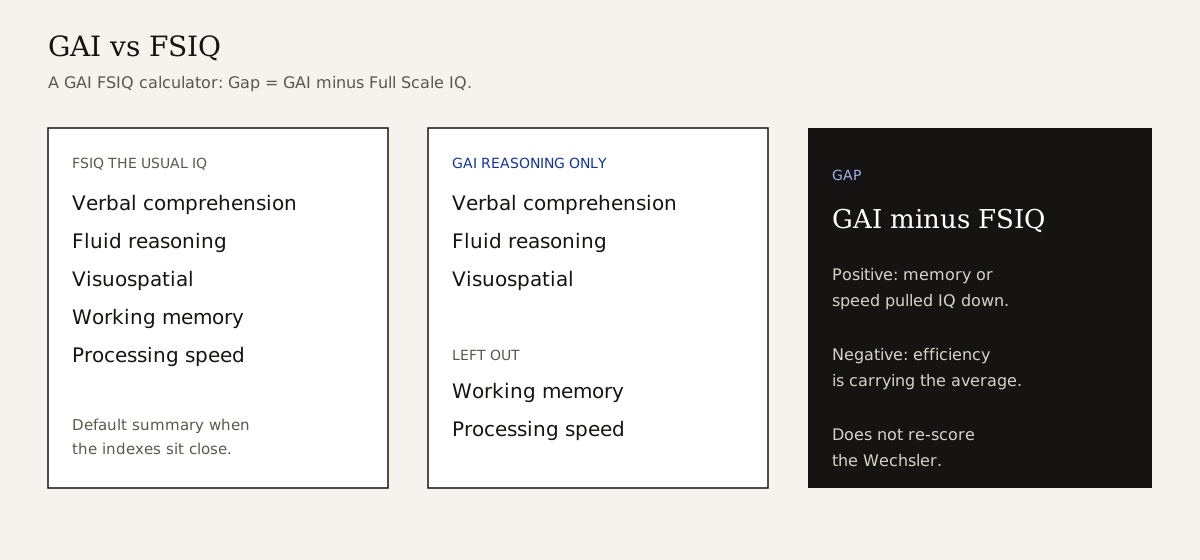
Full Scale IQ is the standard summary of the core battery. When people search “GAI vs IQ,” IQ means FSIQ. It includes verbal comprehension, fluid / visuospatial reasoning, working memory, and processing speed. The manuals still treat FSIQ as the default number unless the profile makes it a bad average.
How does GAI compare to IQ?
FSIQ averages the core indexes. GAI drops working memory and processing speed. On WISC-V, GAI is Similarities, Vocabulary, Block Design, Matrix Reasoning, and Figure Weights. Visual Puzzles is in the Visual Spatial Index and not in GAI. The calculator will not tell you which subtests went into each composite — that depends on the edition. For the named lists, see GAI on the WAIS-IV.
| IQ (FSIQ) | GAI | |
|---|---|---|
| What it measures | Overall ability across the core indexes | Reasoning, without memory and speed |
| Usually includes | Verbal, fluid, visuospatial, working memory, processing speed | Verbal comprehension and fluid / visuospatial reasoning |
| Leaves out | Nothing from the core battery | Working memory and processing speed |
| When it is the better summary | When the indexes sit close together | When memory or speed sit far below reasoning |
When is GAI higher than IQ?
On WAIS-IV, the revised Table C.2 critical values for FSIQ vs GAI are small (often about 3–4 points at p < .05 across ages) because the composites share subtests. A 5-point gap can already be a real difference, not noise.
Clinicians then ask how rare the gap is (base rate), not only whether it is significant. A difference of about 10 points is commonly treated as worth discussing. “Unusual” is often a base rate under 10%, and that threshold varies by ability level. We do not copy Pearson’s base-rate tables.
Our reading bands (under 5 / 5–14 / 15+) are for plain language, not clinical cutoffs. The calculator uses your official numbers. The test uses the same bands on an estimate.
If the higher number is the one you want to trust, walk the checklist on why GAI is higher than IQ before you drop Full Scale IQ. The mechanism — memory and speed left out of GAI — is on working memory, processing speed, and GAI.
A worked GAI vs FSIQ gap
Example: FSIQ 109 and GAI 116. A GAI FSIQ calculator returns +7. That split is large enough to name and small enough that it is not a hidden genius score. FSIQ is still the default summary on the report. GAI says reasoning sat a little above the full-scale average, which usually means working memory or processing speed was the drag.
Flip the same points the other way — FSIQ 116 and GAI 109 — and the same subtraction returns −7. Efficiency is carrying the composite. Do not treat the lower GAI as “the real IQ.” Use Full Scale IQ as the default and treat GAI as the reasoning-only check.
A third case: both numbers 118. The two composites agree. One IQ number is a fair summary. Running a GAI calculator on a flat profile is still useful — it tells you there is no split to explain away a school or work complaint.
What GAI score is gifted?
Many programs use 130, about the 98th percentile on a mean-100, SD-15 metric. Some accept GAI when FSIQ was pulled down by working memory or processing speed. Cutoffs are the program’s, not this site’s. A website cannot place you in a gifted program. The questions to ask a committee are on gifted testing: GAI or FSIQ. Bands and percentile anchors are on what a good GAI score is.
- 130–160 · Very superior / gifted rangeAbout the top 2%
- 120–129 · SuperiorAbout the top 9%
- 110–119 · High averageAbove the mean
- 90–109 · AverageMost scores land here
- 80–89 · Low averageBelow the mean
- 70–79 · BorderlineWell below the mean
- 40–69 · Extremely lowNeeds a clinician, not a website
GAI vs CPI
CPI is the Cognitive Proficiency Index: working memory and processing speed. It is the other half of the story. When GAI sits above FSIQ, CPI is usually the drag. When FSIQ sits above GAI, efficiency is carrying the average. GAI and CPI are not rivals for “the real IQ.” They describe different work. The instrument below is the same reading as the standalone GAI vs CPI calculator. If the report lists the five primary indexes and not CPI, use the Wechsler index calculator.
GAI 118 − CPI 95 = +23
Reasoning outruns efficiency
GAI sits well above CPI. This is the usual shape when Full Scale IQ is pulled down by working memory or processing speed. Untimed reasoning can look stronger than timed or hold-in-mind work. Neither index is the “real IQ.”
GAI High average · 89th percentile of a normal 100/15 curve. CPI Average. Labels are conventional, not a diagnosis.
Does GAI mean the same thing on every Wechsler?
The idea is stable. The subtests are not. WAIS-IV GAI is VCI + PRI. WISC-V GAI is five named subtests. WAIS-5 keeps five primary indexes and still drops WMI and PSI from GAI. A childhood GAI and an adult GAI should not be subtracted from each other as if they were the same exam. Details: GAI on the WAIS-IV.
Laboratory plates. Blue cells enter GAI. Not Pearson product marks.
What a GAI vs IQ calculator cannot tell you
A GAI vs IQ calculator cannot recover subtest scaled scores, cannot say whether a split is rare at your ability level, and cannot decide a school, disability, or employment question. Those answers live in the technical manual and with the person who gave the test. If you do not have official composites yet, the nine-task estimate is a construct-aligned stand-in, not a Wechsler.
Frequently asked questions
What does a GAI FSIQ calculator actually compute?
Only one subtraction: Gap = GAI − FSIQ. You type two official composites from a WISC or WAIS report. The page names the size of the split. It does not re-score subtests, look up Pearson tables, or invent a new IQ.
Is a GAI calculator the same as an IQ test?
No. A GAI calculator reads numbers you already have. An IQ test builds those numbers from tasks. If the report already lists Full Scale IQ and General Ability Index, stay on this page. Take the nine-task estimate only when you have no official composites.
How does GAI compare to IQ?
When people say IQ they usually mean Full Scale IQ. GAI is the reasoning-only summary: verbal, spatial, and fluid work, without working memory or processing speed. The two numbers share subtests, so they move together. A gap means one average is a poor description of the profile, not that one score is fake.
When is GAI higher than IQ?
When working memory or processing speed sit below the reasoning indexes. On a Wechsler, a few points can already be statistically real because the composites overlap. About 10 points is commonly treated as worth discussing. Unusual is a base-rate question. We do not reprint the publisher’s tables.
What GAI score is gifted?
Many programs use 130, about the 98th percentile on a mean-100, SD-15 metric. Some accept GAI when FSIQ was pulled down by memory or speed. Cutoffs belong to the program, not this site. A calculator cannot place you in a gifted class.
Does a GAI vs IQ calculator replace a clinician?
No. It is a reading aid for two numbers on a report you already have. It cannot diagnose ADHD, a learning disability, or giftedness, and it is not a Pearson product.
Can I subtract a childhood GAI from an adult FSIQ?
Not as if they were two sittings of one exam. WISC-V GAI and WAIS-IV GAI do not use the same subtests. Read the gap inside one report first. Then, if you need a story across time, compare the overlapping domains, not a three-point movement in a composite that swapped ingredients.
I already have official scores. Do I need the test?
No. Paste Full Scale IQ and GAI into the calculator on this page. The nine-task battery is for people who do not have a Wechsler report.
Sources
Publisher pages for the batteries these composites come from. Manuals stay with the publisher. We cite them; we do not host them.
- Pearson. WAIS-IV product page. Edition, age range, and the four-index adult battery that GAI on the WAIS-IV is built from.
- Pearson. WISC-V product page. School-age five-index edition. Visual Puzzles is in VSI, not in GAI.
- Pearson. WAIS-5 product page. 2024 adult edition. Five primary indexes. GAI remains an ancillary composite.
- Wechsler, D. (2008). WAIS-IV Technical and Interpretive Manual. Pearson. FSIQ vs GAI as two composites; discrepancy tables; GAI from VCI + PRI (the four-index edition).
- Pearson. WAIS-IV Technical and Interpretive Manual update, Table C.2. Critical values for FSIQ–GAI must account for shared subtests. Statistical significance is often only a few points.
- Wechsler, D. (2024). Wechsler Adult Intelligence Scale, Fifth Edition. Pearson. Five primary indexes: VCI, VSI, FRI, WMI, PSI. GAI remains an ancillary composite that drops WMI and PSI.
- Wechsler, D. (2014). WISC-V Administration and Scoring Manual. Pearson. GAI from Similarities, Vocabulary, Block Design, Matrix Reasoning, and Figure Weights. Visual Puzzles is not in GAI.
- Saklofske, D. H., Prifitera, A., Weiss, L. G., Rolfhus, E., & Zhu, J. (2005). Clinical interpretation of the WISC-IV GAI. Why GAI exists: a general-ability estimate less pulled by working memory and speed.
Scoring formulas and limits: how GAI and IQ are scored. Public copies of the reading note: also published.
Ready when you are
Already have both official scores?
The GAI FSIQ calculator on this page is enough. If you want the same tool without the article, open the standalone page.